


The American automobile industry began about 1900 and drove the U.S. into the Industrial Revolution in the 1920>´s with replaceable parts and the assembly line. The first fifty years was an unruly time with an "anything goes" attitude by manufacturers and consumers alike. These were the years of The Great Depression, two World Wars, and the birth of labor unions. There were no government regulations and little regard for pollution or vehicle safety.
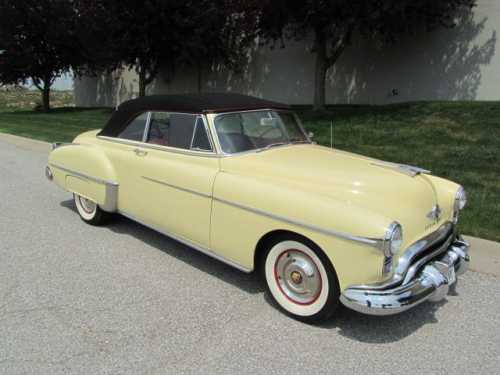
1950 Oldsmobile 88
As the American people recovered from the Second World War they embraced the role of consumer and the annual parade of fancy new cars. For the next ten years the automobile designers lead the way with bigger, better and more powerful cars and factories retooled for new methods of production. Price wars eliminated many small companies, a significant recession put consumers on edge, and the Big Three - Ford, General Motors & Chrysler - emerged as kings.
The Classic Car Era began in 1946 as the Cold War, the Communist threat in Cuba, civil rights and Vietnam brought new strife and concerns to the American people. The 1960´s also brought new concerns for Detroit. As foreign automakers imported a new breed of compact, more efficient cars American automakers responded by dropping their trademark fins and consumers eagerly accepted GMs´ all new Corvair, fords´ Falcon and Chryslers´ Valiant. The smaller cars went faster and the introduction of the Big Block V-8´s assured Americans that the horsepower war was still on.
By 1964 the Big Three had stuffed V-8 engines into their mid-size cars and the Muscle Car was born with names like Chevrolet Camaro, Pontiac Firebird and Plymouth Barracuda. Throughout this new profusion of speed and visual marketing AMC managed to hold on to a distant fourth place but in 1966 Studebaker closed its doors.
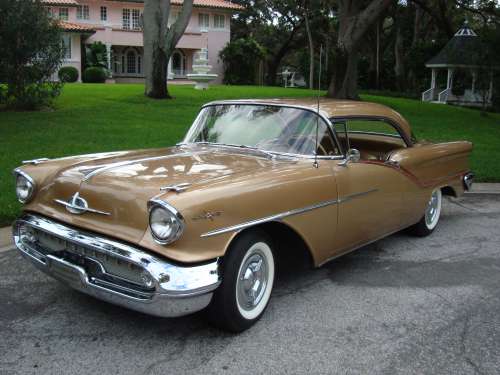
1957 Oldsmobile 98
The American automobile industry was knocked to its knees in the 1970´s by two significant events. First, the Clean Air Act of 1970 practically killed the use of high performance engines over the next few years. And then the oil embargo in the winter of 1973 encouraged consumers to conserve gasoline. By 1978 Congress had passed the Corporate Average Fuel Economy (CAFE) rule and Detroit was scrambling to comply. The gas-guzzlers of the past were replaced by smaller, more efficient vehicles modeled after the ever-present imports and an all new race for fuel economy supremacy began, marking the end of what may consider to be the Classic Car Era. However the term "classic car" has come to symbolize any vehicle that has everlasting appeal to consumers.
According to Dietrich Hatlapa, founder of the HAGI (Historic Automobile Group International) Indices classic car prices can be affordable and the cars can be a good investment. They are sold and resold worldwide through private sales, auctions and classified ads. There are classic car dealers who specialize in appraisals, and providing insurance, financing and loans, selling classic cars through public auctions and online.
* The Classic Car Era does not necessarily define classic cars. For instance, many DMVs define a classic car as any vehicle over 15-25 years old and the Classic Car club of American defines classic cars as "a ´fine´ or ´distinctive´ automobile, either American or foreign built, produced between 1925 and 1948. They are also sometimes called ´Full Classics,´ or just plain ´Classics´ (with a capital 'C'). Generally, a Classic was high-priced when new and was built in limited quantities. Other factors, including engine displacement, custom coachwork and luxury accessories, such as power brakes, power clutch, and ´one-shot´ or automatic lubrication systems, help determine whether a car is considered to be a Classic."
For pictures of some of the best classic cars and trucks advertised on AntiqueCar.com, visit our Classic Car & Truck Photo Gallery.